
In this guide
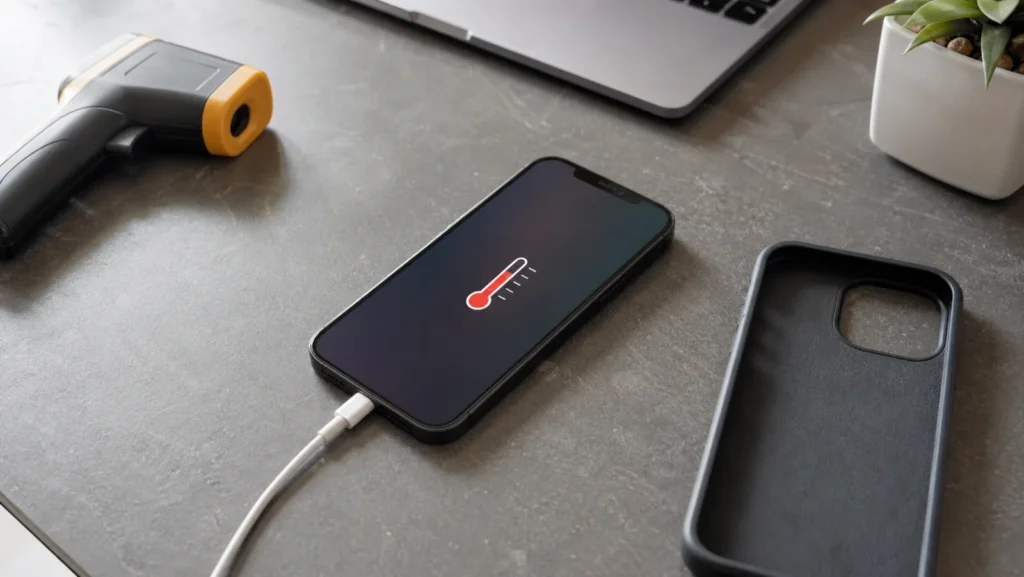
An iPhone 14 feeling warm while charging is not automatically overheating. Charging, restoring a backup, installing an update, gaming, navigation and wireless charging all create heat. The useful question is whether the warmth stops after the workload ends or whether iOS limits charging, dims the screen, shows a temperature warning, or the phone becomes painful to hold.
Separate normal warmth from a thermal warning
| What happens | Most useful interpretation | Next action |
|---|---|---|
| Slightly warm, charge continues | Normal conversion and battery heat may be present | Repeat with screen locked |
| Warm during restore or update | Background processing adds load | Allow the task to finish in a cool room |
| Charging On Hold appears | iOS has limited charging for temperature | Unplug and let temperature normalize |
| Screen dims and charging slows | Thermal management is active | Stop heavy apps and move out of heat |
| Swelling, odor, smoke or painful heat | Potential battery or electrical hazard | Stop using it and seek service |
Apple’s temperature protection changes phone behavior
Apple specifies an ambient operating range of 0 to 35°C for iPhone and explains that charging can slow or stop outside normal temperature conditions. Other protective changes can include a dim or black display, weaker cellular performance, a disabled flash and reduced frame rates. These are system responses, not separate proof that every affected part has failed.
If the lock screen says Charging On Hold, do not try to bypass it. Charging resumes after the device returns to a normal temperature. Never use a refrigerator, freezer, ice pack or direct blast of very cold air; rapid cooling can create condensation.
Run one controlled wired-charge test
- Note the battery percentage, room conditions and whether a restore or update is running.
- Close games, camera, navigation, hotspot and high-quality video.
- Remove the case temporarily and place the phone on a hard, shaded surface.
- Use a compatible wall adapter and an undamaged USB-C-to-Lightning cable.
- Lock the screen for 15 minutes without handling the phone.
- Record percentage gained, any message, where the warmth is strongest and whether it stabilizes.
Do not compare a test at 25% with one at 90%; charging naturally tapers near full. Apple notes that iPhone 14 and earlier use USB-C-to-Lightning for faster wired charging. A low-power USB port, damaged cable or multiport charger sharing power can extend charge time and keep radios or the display active longer.
Compare cable, adapter and outlet one at a time
| Comparison result | Evidence gained | Decision |
|---|---|---|
| Cooler with another cable | First cable may have resistance or damage | Retire the suspect cable |
| Only one adapter becomes very hot | Adapter or compatibility is suspect | Stop using that adapter |
| Wall outlet works better than laptop USB | Previous source supplied less power | Use the proper wall adapter |
| Every wired setup heats similarly | Phone workload, port or battery needs review | Check Battery settings and service data |
| Connector heats or needs an angle | Unstable cable or Lightning port | Disconnect and inspect externally |
Inspect the cable for fraying, dark marks or a loose connector. Look into the Lightning port with good light, but do not insert metal, liquid or compressed air. If charging cuts out when the plug moves, use the charging-port diagnostic path rather than holding the cable at an angle.
Wireless charging creates a different heat pattern
Wireless charging is less efficient than a cable and normally produces more heat. Misalignment, a thick case, cards, metal objects or simultaneous wired accessories can make it worse. Center the phone on a compatible MagSafe or Qi charger, remove objects between them and ensure the charging pad has its specified power adapter.
For diagnosis, compare one wired test with one wireless test at similar battery levels and room temperature. If only wireless charging triggers rapid heat, investigate pad alignment, case and adapter before blaming the battery.
Check Battery activity for the hidden workload
Open Settings > Battery and review activity around the hot period. A game, camera, navigation, poor-signal cellular connection, photo indexing or restore can consume power while the charger supplies it. After a major update or restore, allow background work to finish on Wi-Fi in a cool location.
Update iOS through the normal Settings path after backing up, because software and app behavior can affect workload. Do not install “cooler” or “battery repair” apps; an app cannot cool hardware and may simply close processes without identifying the cause.
When battery health and service become relevant
Review Settings > Battery > Battery Health & Charging for a service message or unusually reduced capacity. Capacity alone does not diagnose heat, but repeated thermal limiting under light use, shutdowns, rapid drain and a service warning form stronger evidence together. Our battery-health decision guide explains when an 80% reading matters.
Stop immediately for swelling, screen separation, smoke, chemical odor, liquid exposure or heat that is painful to touch. Do not press a raised screen or continue charging to make a backup. Record the model, iOS version, battery health, charger and exact warning for Apple Support. For the Arabic warning workflow, see Charging On Hold.
Sources and review
- Apple: if iPhone gets too hot or too cold
- Apple: thermally limited charging
- Apple: iPhone charge speeds
Frequently asked questions
Is it normal for iPhone 14 to get warm while charging?
Mild, stable warmth can be normal. A warning, paused charging, painful heat or swelling is not a condition to ignore.
Should I place a hot iPhone in the refrigerator?
No. Unplug it and let it cool gradually in a shaded, ventilated room.
Does MagSafe make more heat than a cable?
Wireless charging commonly creates more heat; compare alignment, case and adapter with a controlled wired test.