
English Repair Guides Published: Updated: 7 min read

Xbox Black Screen or No Signal: HDMI, TV Input, or Video Settings?

A safe Xbox black screen checklist for HDMI cable, TV input, resolution mismatch, display mode, and hardware warning signs.

Xbox Black Screen or No Signal: HDMI, TV Input, or Video Settings? - Xbox black screen no signal
Safety note: Disconnect power or water when needed, and do not open electrical or gas appliances unless you are qualified.

Fast decision

Before you replace a part or pay for service

Use this compact map to decide whether to start with a safe check, match the code, or stop and ask for qualified support.

Device
Xbox console
Symptom
black screen, No Signal, flickering video, or unsupported display mode
Code
No Signal, black screen, or unsupported resolution
01

Check safely

Start with visible, external checks before opening anything or touching power.

02

Match the code

Confirm the device, message, and code before applying a generic fix.

03

Stop at risk

Burning smell, water near power, swollen battery, or abnormal heat means stop.

Last updated: 2026-07-01

Sources and review for this guide

This article connects the visible symptom to the device or code, then orders safe checks before any internal or risky step.

DeviceXbox console ModelXbox Series X|S or Xbox One connected by HDMI Problemblack screen, No Signal, flickering video, or unsupported display mode Error codeNo Signal, black screen, or unsupported resolution Search intentFix Xbox black screen or No Signal without damaging the HDMI port or resetting the console too early.

Review method

  1. Match the device type and code or message before interpreting the cause.
  2. Start with safe external checks such as cable, filter, hose, airflow, settings, or one restart.
  3. Stop at electricity, gas, water near power, swollen batteries, painful heat, or internal disassembly.

Broader diagnostic path

Related topic hubs

If this symptom belongs to a recurring device or brand issue, use these hubs to compare codes and symptoms before replacing parts or resetting everything.

Wi-Fi Wi-Fi and router problems Weak signal, Mesh, DNS, high ping, and disconnections. Open hub TV مشاكل الشاشات والتلفزيون الصورة والصوت والريموت والتطبيقات وHDMI. Open hub

Quick diagnosis

What should you check first?

A safe Xbox black screen checklist for HDMI cable, TV input, resolution mismatch, display mode, and hardware warning signs.

Device
Xbox console
Model
Xbox Series X|S or Xbox One connected by HDMI
Problem
black screen, No Signal, flickering video, or unsupported display mode
Code
No Signal, black screen, or unsupported resolution
Search intent
Fix Xbox black screen or No Signal without damaging the HDMI port or resetting the console too early.

Read the steps in order, and stop at electricity, gas, batteries, or any visible risk.

Do not start with a factory reset; the faster split is cable, TV input, resolution, or a loose HDMI port. This guide is built around a simple rule: identify the exact device, model, symptom, and risk level before spending money on parts or service.

What this guide covers: This guide explains how to diagnose black screen, No Signal, flickering video, or unsupported display mode on Xbox console in the Xbox Series X|S or Xbox One connected by HDMI context, including the visible code or alert No Signal, black screen, or unsupported resolution, safe first checks, stop conditions, and when support is needed.
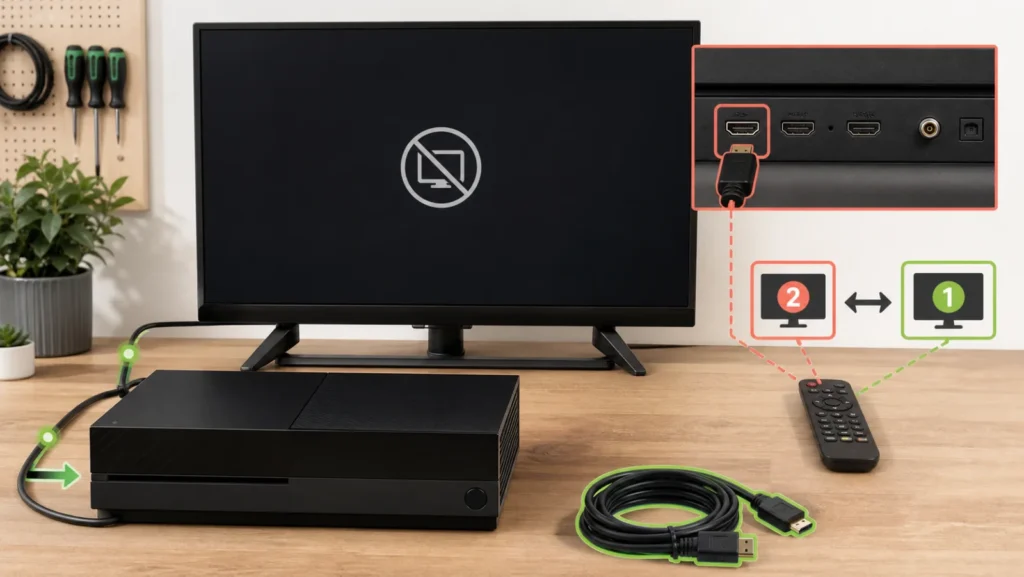
Fast answer: Confirm the TV is on the correct HDMI input, reseat a known-good HDMI cable, try another HDMI port or display, power cycle the Xbox and TV, then adjust display resolution or video settings if the console appears on a second screen.

Device, model, and search intent

The target device is Xbox console, the model context is Xbox Series X|S or Xbox One connected by HDMI, and the visible problem is black screen, No Signal, flickering video, or unsupported display mode. The code or alert to document is No Signal, black screen, or unsupported resolution. This matters because generic advice can be wrong when an error code has different meanings across brands or when a phone protects itself from heat or moisture.

Before changing settings, replacing a charger, ordering a pump, or booking service, write down the exact moment the issue appears. Does it happen at startup, while charging, during a drain cycle, after an update, under heat, or after water exposure? That timeline often separates an external condition from an internal failure.

First screen decision: continue, pause, or stop

If there is heat, water, smoke, electrical smell, swelling, a leak, or a repeated safety warning, the right move is to pause. Safe troubleshooting means external checks only: cables, hoses, filters, settings, airflow, and official documentation. It does not mean opening a sealed phone, touching appliance wiring, or bypassing a safety system.

If the device is still usable, gather evidence before resetting anything. Photos of the message, model label, battery screen, or appliance display can save time and prevent a technician from guessing. If the device is not safe to use, disconnect it only when you can do so without touching water or hot parts.

Signals that narrow the cause

  • The TV shows No Signal while the Xbox power light is on.
  • The Xbox logo appears, then the screen goes black.
  • The same HDMI cable works with another device but not the Xbox.
  • A second TV or monitor works normally.
  • The HDMI connector feels loose or loses picture when touched.

Safe checks in order

  1. Select the exact HDMI input where the Xbox is connected.
  2. Unplug the TV and Xbox from power for one minute, then reconnect.
  3. Test a short known-good HDMI cable and avoid adapters for the first test.
  4. Move the cable to another HDMI port on the TV or use a second display.
  5. If video appears on another display, lower the resolution or review Xbox display settings.
  6. Stop if the HDMI port is loose, cracked, or physically damaged.

How to read the result

A useful test changes only one variable at a time. If you change the charger, location, cable, app, hose, and filter all at once, you may make the problem disappear without learning what fixed it. Repeat the most important test under normal conditions before deciding that the issue is solved.

If the issue appears only with one accessory, room, cycle, load, or cable, the device itself may not be the root cause. If the issue appears across trusted accessories and normal conditions, the chance of a service-level fault rises. That is when your notes, photos, and official-source checks become valuable.

Quick decision table

What you seeWhat it may suggestBest next step
The issue appears only in one conditionExternal cause is possibleChange one factor and test again
The issue returns after safe checksA part or sensor may need diagnosisStop repeated attempts and document results
Heat, water, burning smell, or battery swelling appearsSafety riskDisconnect safely and seek qualified service

Common mistakes that make this worse

Most expensive repair mistakes start with impatience: forcing a device to keep running, assuming one error code means the same thing on every model, or replacing parts without a documented reason.

  • Factory resetting the console before testing the HDMI path.
  • Forcing the cable into a misaligned HDMI port.
  • Changing many TV settings before confirming the selected input.
  • Using a long damaged HDMI cable for 4K or high refresh video.
  • Ignoring signal loss when the cable moves.

When home troubleshooting is not enough

Stop when the next step requires opening the device, measuring live electricity, handling a battery, touching water near power, moving a heavy appliance in an unsafe way, or bypassing a warning. A good repair decision is not only about cost; it is about avoiding damage, leaks, data loss, and personal risk.

When you contact support or a technician, ask them to connect the proposed repair to the exact symptom and model. A professional answer should explain why a part is likely faulty, what was ruled out, and what warranty applies after the repair.

Prepare this before contacting support

  • Xbox model and software version if visible.
  • TV or monitor model and HDMI port number.
  • Cable type and whether another cable was tested.
  • Whether the Xbox appears on a second display.
  • Photo of the HDMI port if damage is suspected.

Prevention checklist

  • Avoid moving the console with HDMI connected.
  • Use a cable rated for the display mode you want.
  • Leave room behind the console so the cable is not bent.
  • Change video settings one at a time.
  • Protect HDMI ports during travel and cleaning.

Related guides

Sources and references

This article uses manufacturer support pages and treats model-specific instructions as higher priority than generic forum answers.

FAQ

Why does my Xbox show a black screen or No Signal?

The most common causes are the wrong TV input, a bad HDMI cable, a resolution mismatch, display settings, or a damaged HDMI port.

Should I reset my Xbox for a black screen?

No. Test the HDMI cable, TV input, another display, and video settings first so you do not erase settings for a simple cable problem.

When is repair likely?

Repair becomes likely when the HDMI port is loose, visibly damaged, or the picture drops whenever the connector moves.

Safety note: This guide is for safe external diagnosis. Any internal inspection involving electricity, gas, batteries, sealed parts, or water near power should be handled by a qualified professional.

Prepared and reviewed by

SMSM Hub Editorial Team

The SMSM Hub editorial team reviews repair, phone, and internet guides with a method focused on safe external checks, clear steps, and knowing when a qualified technician is needed.

About the editorial team Safety and review method

Content review and safety

  • Last updated: 2026-07-01.
  • Category: English Repair Guides.
  • This guide focuses on safe external checks and does not encourage opening appliances or working with electricity, gas, or batteries.
  • If you spot information that needs correction, contact us from the contact page.

Read our editorial and review policy

Did this guide help?

If a step is unclear or your device behaved differently with the same fault, send us a note. Reader feedback helps us update guides and correct anything that needs review.