
In this guide
Bosch E24 is a drain-path error, but “replace the pump” is not a first diagnosis. The drain chain has several checkpoints: filter, pump cover, pump area, hose, air gap or siphon, and a new disposer connection. The point where water stops tells you more than repeated resets.
Locate the restriction by what the machine does
| Observation | Likely checkpoint | Next safe action |
|---|---|---|
| Water remains with food debris in filter | Filter or pump inlet | Remove water and clean the filter |
| E24 began after filter cleaning | Pump cover not fully latched | Refit it until the manual-specified click |
| E24 began after new disposer installation | Knockout plug may remain | Have the disposer connection checked |
| Gurgling at sink or air gap | Shared drain connection restriction | Inspect the accessible air gap or siphon |
Work from the tub outward
Turn off power and water before reaching into the sump. Wear gloves because broken glass may hide under cloudy water. Remove the lower rack, sponge out standing water, and lift the filter as the owner manual shows. Do not use drain cleaner: it can damage components and leaves hazardous liquid for the next person.
The pump cover must be seated correctly. If the model permits access, remove only loose debris without forcing the impeller. Reinstall every part before testing. The Arabic Bosch E24 guide, French E24 guide, and Spanish E24 guide provide companion terminology for multilingual households.
Inspect the hose and sink connection
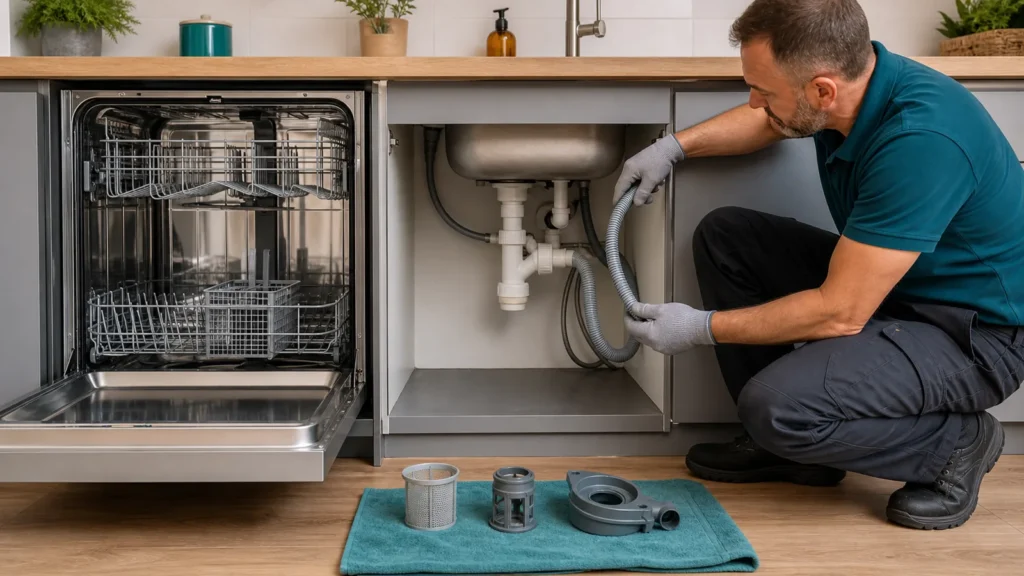
Follow the drain hose without pulling the dishwasher from cabinetry unless the manual allows it. Look for a sharp bend, crushed section, or incorrect high loop. At the sink, inspect the accessible air gap or siphon. A recently installed garbage disposer is a strong clue: its dishwasher inlet may still contain the factory knockout plug. That is an installation issue, not proof of a failed dishwasher pump.
| After one drain test | Meaning | Decision |
|---|---|---|
| Water leaves normally and E24 clears | Removed restriction or corrected cover | Monitor the next full cycle |
| Pump hums but no water moves | Remaining blockage or pump fault | Stop repeated tests and request service |
| Water leaks under cabinet | Connection or seal problem | Shut water and power off |
| E24 returns with a clear accessible path | Hidden hose, pump, or control diagnosis needed | Provide E-Nr and test results to Bosch |
Reset only after correcting the cause
A reset clears the current program; it does not remove a kink or debris. Use the button sequence in the exact owner manual, then run one short rinse/drain test. Record the E-Nr, where water remained, pump sound, recent plumbing work, and which parts were removed. Stop if you cannot latch the cover, encounter glass, or need to disconnect fixed plumbing.
Separate a slow drain from a no-drain event
Before the test, mark the standing-water level with a photo. A pump that removes some water and then stops suggests a partial restriction or path that changes under flow; no movement with a hum points elsewhere. Listen from outside the closed cabinet and never run the pump with covers removed. Check whether the sink also drains slowly, because a shared plumbing restriction can make the dishwasher appear faulty.
If E24 began immediately after cabinet work, a new sink, disposer, or moving the appliance, tell support before parts are ordered. Hose routing and a closed disposer inlet are installation clues. If it appeared gradually with debris in the filter, document cleaning frequency and the object removed. Do not push wire, compressed air, or chemicals through the hose; they can damage a check valve or send contamination back into the sump.
What to send Bosch or a technician
Provide the E-Nr and FD number from the label, the exact point in the cycle where E24 appears, water level, pump sound, and whether the sink or air gap gurgles. List each part you removed and confirm the pump cover clicked into place. This evidence distinguishes routine maintenance from hidden hose, pump, or installation work and avoids repeating unsafe tests.
Sources and review
We used Bosch’s official E24 support page, its broader dishwasher error-code reference, and the Bosch troubleshooting guide. Access and reset steps vary by E-Nr.